
When Does an Aircon Actually Need a Gas Top-Up?
Aircons are sealed systems — they shouldn't lose refrigerant under normal operation. If yours needs frequent top-ups, the real fix is leak repair, not more gas. Here's how to tell the difference.
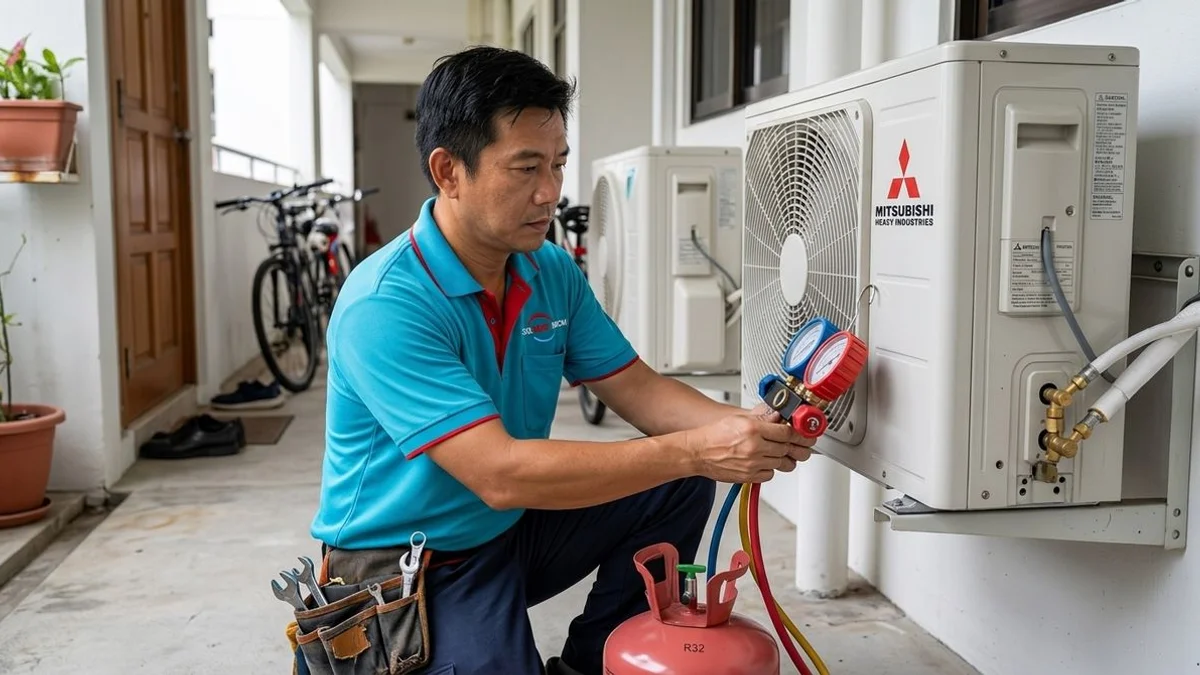
“My aircon needs a gas top-up” is one of the most common requests we get — and one of the most commonly misdiagnosed. About half the time, the actual fix isn’t an aircon gas top-up at all. Of the rest, most need a leak repair before any top-up makes sense.
This guide explains when a gas top-up is genuinely the right answer, and when it isn’t. If you’re unsure which refrigerant your unit runs on before booking, see our R32 vs R410A explainer.
The honest baseline: aircons don’t normally need top-ups
A residential aircon is a sealed refrigerant loop. Under normal operation, refrigerant doesn’t get consumed or evaporate — it cycles indefinitely. A properly installed system can run 10+ years on the original factory charge.
So the question isn’t really “when do I need a top-up” — it’s “what made me lose refrigerant in the first place.” There are only a few legitimate reasons:
Reason 1: Slow leak at a brazed joint (most common)
When refrigerant escapes, it’s almost always through a tiny pinhole at a copper-to-copper braze joint — usually at the indoor or outdoor coil headers, or at the service ports.
Symptoms:
- Cooling weakens slowly over weeks or months (not suddenly)
- Ice may form on the larger copper pipe at the outdoor unit
- Sometimes a faint chemical smell near the indoor unit
- A whistling noise from the leak point
The right fix here is leak detection + repair + top-up, not top-up alone. We use electronic leak detectors and bubble solution to pinpoint the leak, braze the joint, then evacuate and recharge to factory spec.
A top-up alone on a leaking system is a waste of money — you’ll lose the new charge in roughly the same time as the original.
Reason 2: Recent servicing that opened the refrigerant lines
If a technician recently disconnected refrigerant lines (for example, to replace a coil, move the indoor unit, or repair a major leak), refrigerant has to be recovered before disconnection and recharged after reconnection. Top-up in this case is part of the service, not a sign of a problem.
Coolbest always recovers and weighs refrigerant before any pipework, so we know exactly how much to recharge. Some less careful technicians “guess” — which is how systems end up undercharged or overcharged.
Reason 3: Sudden major leak (rare)
Sudden full-charge loss is unusual but happens — typically from a cracked coil after a hailstorm (very rare in Singapore), a rodent chewing the insulation off a copper line, or a corroded service valve.
Symptoms:
- Cooling fails completely or near-completely within hours
- You may hear a hiss when the leak first happens
- No ice formation (system can’t run long enough to ice up)
For sudden major leaks, the right fix is the same: locate, repair, recharge. No useful purpose to topping up before the repair.
When a top-up is NOT the right answer
If your aircon is “not cold” or “not cold enough,” the cause is more likely one of these — not low refrigerant:
- Dirty filter or biofilm-coated coil (the most common cause — restricted airflow makes the unit feel weak)
- Failing capacitor (compressor runs inefficiently)
- Frozen evaporator coil (which can be caused by low refrigerant, but more often by airflow issues)
- Dirty outdoor condenser (can’t reject heat efficiently)
- Wrong thermostat setting (unit cycles off too quickly)
Our diagnostic process always starts with these before we test refrigerant pressure. About half of “I need a top-up” calls turn out to be one of the above — saving the customer S$100+ on unnecessary refrigerant.
For a fuller breakdown, see our guide on why your aircon is not cold.
How a proper top-up visit works
When pressure testing confirms the system is genuinely undercharged AND there’s no active leak (or the leak is small and accepted), the top-up procedure is:
- Pressure test the system at the service ports to confirm the charge level
- Connect a calibrated refrigerant cylinder with a precision scale
- Add refrigerant by weight to factory spec (printed on the outdoor unit nameplate)
- Run the system and verify pressures stabilise at expected operating values
- Leak check the service connections after disconnection
- Document the amount added and any leak findings
Total time on-site: 60–90 minutes. Cost: S$80–S$200 depending on refrigerant type and amount needed.
What we’ll tell you that other companies might not
If we pressure-test and find the system is at correct charge, we’ll tell you that — and decline to add refrigerant. The diagnostic fee (S$80) still applies, but we don’t charge for top-up gas you don’t need. This costs us a few jobs in the short term and keeps customers in the long term.
Red flags to watch for in a top-up quote
- “Refrigerant top-up by visual inspection only” — no proper top-up should happen without pressure testing first
- “Topping up R32 with R410A because it’s cheaper” — cannot be done, will damage the compressor
- “You need a top-up every year” — this means leak repair, not endless top-ups
- “Top-up will improve cooling on your working unit” — false, will make it worse
Booking
WhatsApp +65 9182 5233 with:
- Brand and approximate age
- Symptoms (warm air, ice on pipe, when it started)
- Whether the unit has been topped up before, and how often
We’ll come back with a likely diagnosis (could be top-up, could be something else) and a slot offer. Pressure-test diagnosis is S$80 and is waived if you proceed with the top-up.