
Aircon Not Cold? 7 Common Causes & Fixes
Warm air from the aircon is one symptom with seven possible causes. Here's how to narrow it down before booking the diagnosis — and what each fix realistically costs.
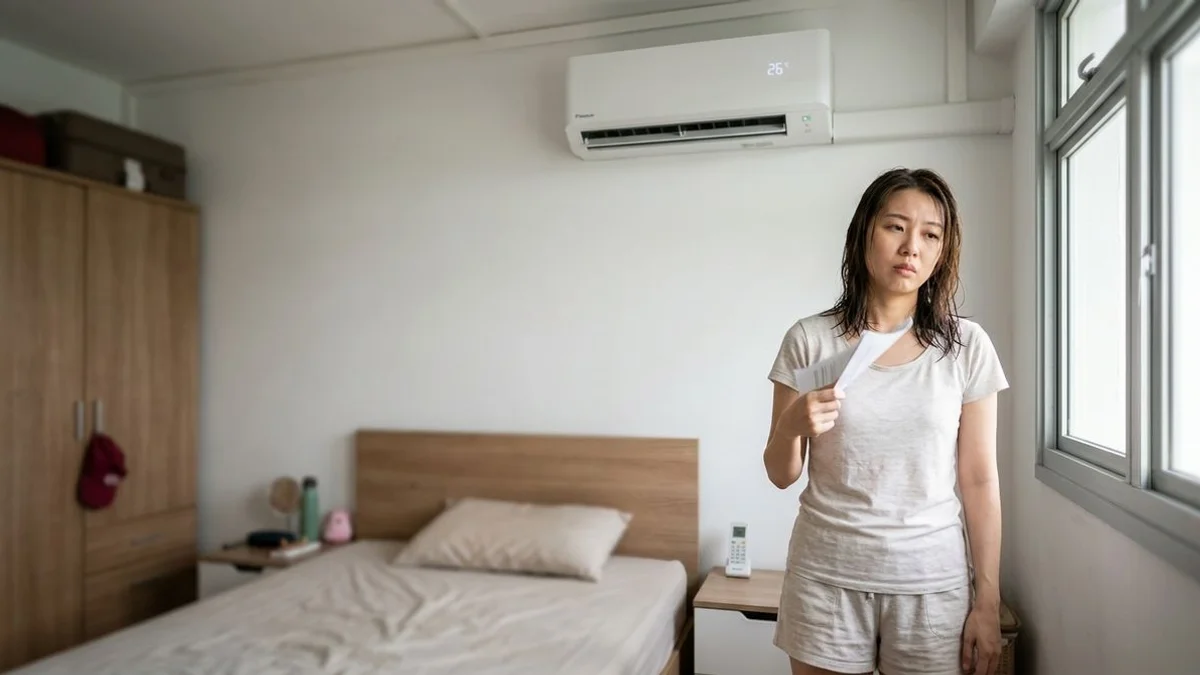
Warm air from an aircon that should be cooling is one of the most common Singapore service calls. It’s also one of the most ambiguous symptoms — there are at least seven distinct causes, with very different fix costs. The good news: most are a quick aircon repair once you know which one is at play.
This guide walks through them in order of likelihood and cost-to-fix, so you can have an informed conversation when you book the diagnosis. If water is also dripping from the unit, read our companion guide on aircon leaking water.
1. Dirty air filter or clogged evaporator coil
Frequency: most common cause (~35% of “not cold” calls). Fix: routine servicing or chemical wash, S$50–S$90 per fan coil.
A blocked filter restricts airflow across the cooling coil. The coil temperature drops below freezing, frost forms, and the cooling output collapses. The unit appears to be running normally but the supply air is barely cool.
The same effect happens when the coil itself is biofilm-coated (visible behind the front louvre). Routine quarterly servicing prevents this; if it’s been 4+ months since the last service, this is the first thing to check.
2. Low refrigerant (R32 or R410A leak)
Frequency: 25% of cases. Fix: leak test + refrigerant top-up, S$80–S$200 depending on gas type and leak size.
If the system has slowly leaked refrigerant, the compressor still runs but doesn’t have enough working fluid to absorb heat. Symptoms include weak cooling, longer-than-usual run times, and sometimes ice on the copper pipe outside.
We pressure-test before topping up. If the leak is significant, repairing it is the right answer — topping up a leaking system buys you weeks, not months.
3. Frozen evaporator coil
Frequency: 15% of cases. Fix: identify root cause (low gas, blocked airflow), then service or top-up, S$80–S$200.
A frozen coil shows up as visible frost or ice on the indoor unit when you open the front panel. The freeze is caused by either restricted airflow (dirty filter/coil) or low refrigerant (the suction-side temperature drops too low).
Switch off the unit and let it defrost (1–2 hours) before any further investigation. Running a frozen system damages the compressor.
4. Failing capacitor
Frequency: 12% of cases. Fix: capacitor replacement, S$120 typically.
The start capacitor in the outdoor condenser provides the surge of current to start the compressor. As capacitors age (typically 6–10 years), their capacitance degrades. The compressor still starts but runs inefficiently, producing less cooling per kWh.
Symptoms: humming or buzzing from the outdoor unit, slow cooling that gradually got worse over weeks. We test capacitors with a multimeter — a 5-minute check.
5. Dirty outdoor condenser
Frequency: 8% of cases. Fix: condenser cleaning, included in routine servicing.
A condenser blocked with leaves, dust, or other debris can’t reject heat efficiently. The compressor runs longer and the cooling weakens. This is purely a cleaning issue, not a refrigerant or part issue.
Routine quarterly servicing includes a condenser fin brush. If you’ve skipped servicing for 6+ months, this could be the cause.
6. Thermostat or remote control fault
Frequency: 3% of cases. Fix: replace remote (S$50–S$120) or thermostat sensor (S$80).
If the remote is sending incorrect setpoint data, or the thermostat sensor inside the unit is reading inaccurately, the unit may think the room is already at temperature when it isn’t. Symptoms: unit cycles off too quickly, or fan runs but compressor doesn’t engage.
Easy first check: try a fresh set of remote batteries.
7. Compressor failure
Frequency: 2% of cases (mostly older units). Fix: compressor replacement (S$700+) or unit replacement (S$1,100+).
The compressor is the most expensive single component. When it fails, repair costs often approach the cost of a new unit. We always recommend a side-by-side cost comparison with replacement before quoting a compressor swap.
For units older than 10 years with a failed compressor, replacement is usually the better answer.
How we diagnose in 20–30 minutes
When you book a diagnosis, the on-site sequence is:
- Visual check of filter and front louvre (rule out dirty filter)
- Visual check inside the fan coil (rule out frozen coil, biofilm)
- Pressure test at the outdoor service port (rule out low refrigerant)
- Capacitor test with multimeter (rule out failing capacitor)
- Condenser visual (rule out dirty condenser)
- Remote and thermostat test (rule out control fault)
- Compressor amperage check (rule out failing compressor)
By step 4 we usually know the cause. Steps 5–7 confirm or rule out the rarer scenarios.
What it costs
Diagnosis: S$80, waived if you proceed with the repair.
Typical repair costs:
| Cause | Typical fix | Cost |
|---|---|---|
| Dirty filter/coil | Routine service or chemical wash | S$50–S$90 |
| Low refrigerant | Top-up (after leak test) | S$80–S$200 |
| Frozen coil | Defrost + root-cause fix | S$80–S$200 |
| Failing capacitor | Capacitor replacement | S$120 |
| Dirty condenser | Condenser clean | S$50–S$80 |
| Thermostat fault | Sensor or remote replacement | S$50–S$120 |
| Compressor failure | Compressor or unit replacement | S$700+ |
Book a same-day diagnosis
WhatsApp +65 9182 5233 with the brand, age, and a brief description (“warm air after 30 minutes of running” works fine). Most West Region addresses see a technician inside 90 minutes during business hours.