
DIY vs Professional Aircon Cleaning: What HDB & Condo Owners Need to Know
Some aircon cleaning is fine to DIY. Most isn't. Here's the honest split for Singapore HDB and condo owners — and why getting it wrong can void your warranty.
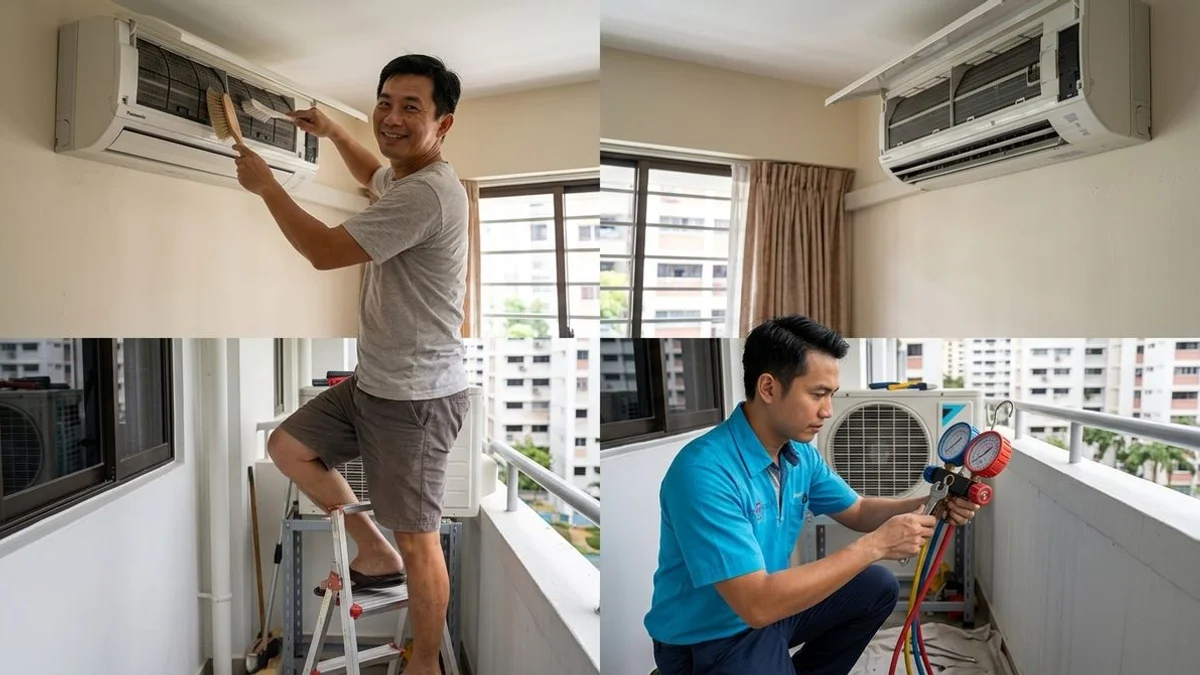
Almost every Singapore HDB and condo owner has, at some point, stood on a chair with a damp cloth and asked: can I just clean this myself?
The honest answer is: yes for some things, no for others. This guide draws a clear line between the two — what’s safe to do yourself, what’s not, and why the cost gap between DIY and a proper aircon chemical wash is smaller than people assume. If you want to see exactly what pros do on a visit first, what’s included in standard servicing has the full checklist.
What you can safely DIY
Filter rinsing (do this monthly)
Every aircon has a filter behind the front louvre — a thin mesh that catches dust before air passes the cooling coil. Sliding it out, rinsing it under cold tap water, letting it air-dry, and slotting it back is genuinely simple work that takes 5 minutes per unit. Do this monthly in Singapore — the filter visibly browns within 4–6 weeks of normal use.
A clean filter is the single biggest factor in keeping your aircon running efficiently. A blocked filter forces the unit to work harder, which raises your SP Group bill by 10–20% and accelerates wear on every other component.
Front panel and louvre wipe-down
The plastic front panel and the horizontal louvre vanes can be wiped with a damp microfibre cloth. Just unplug the unit first. Don’t use bleach (it discolours plastic) or solvents (they crack ABS).
Outdoor condenser visual check
Walk around the outdoor unit (the box on the external wall). Brush off visible leaves or large debris with a soft brush. Do not spray it with water — the electrical contactor inside is not waterproof, and water-jet cleaning can drive grit deeper into the fins.
What you cannot safely DIY
Coil chemical wash
The aluminium evaporator coil sits behind the blower. Reaching it requires partial dismantling — removing the front panel, sometimes the louvre assembly, and often the blower wheel. Even then, the coil fins are fragile (0.1mm thick aluminium) and bend permanently under finger pressure.
The solutions used for proper chemical wash are alkaline cleaners formulated for aircon coils. The diluted versions sold for DIY are safe to handle but too weak to strip biofilm. The industrial versions are strong enough to cause chemical burns on bare skin.
Drain pipe descaling
The drain pipe runs from the indoor unit’s drain pan to either an external outlet or a condensate pump. Over time it scales up with biofilm and limescale. A pressure flush requires a hand pump, an end-cap, and the willingness to handle the dirty water that comes out.
Refrigerant pressure check
Pressure checking requires a manifold gauge with the correct refrigerant fittings (R32 and R410A use different sizes). Reading the gauges correctly requires knowing the ambient and supply-air temperatures and cross-referencing the manufacturer’s pressure-temperature chart.
Capacitor or contactor inspection
The outdoor condenser contains a start capacitor that holds a residual charge even when the breaker is off. Touching the wrong terminal can deliver a 400V shock. We don’t recommend opening the outdoor unit unless you know what you’re doing.
How DIY can void your warranty
Daikin Singapore, Mitsubishi Electric Singapore, and Panasonic all require service by an authorised technician at least once a year for the parts warranty to remain valid. Most manufacturer warranties also exclude damage caused by improper cleaning (bent fins, damaged drain pan, water-damaged electronics).
If your unit is still under the manufacturer’s parts warranty (typically 1–5 years depending on brand), DIY beyond filter cleaning is a financial risk that’s rarely worth taking.
What it actually costs to hire a professional
Per-unit servicing in Singapore ranges from S$30 (suspiciously low — usually a bait price) to S$80 (high-end branded). Coolbest’s published rates are S$50 for one unit, S$55 for two, S$70 for three, S$85 for four, S$100 for five, S$115 for six.
For a typical 4-room HDB flat with three to four aircons, professional servicing costs S$70–S$85 per visit. A DIY kit (filter wash brush, soft cloths, mild detergent) costs around S$40–S$60 to assemble — and only covers the filter and front panel, not the coils or drain.
In other words: hiring a professional costs roughly the same as a proper DIY setup, and gets the parts you can’t safely reach.
When DIY is the right answer
There’s exactly one scenario where DIY is the right call: monthly filter cleaning between professional services. Doing this prevents 40% of the buildup that would otherwise need a technician to address.
Anything beyond that — coils, drain, refrigerant, electronics — is not worth the risk to your warranty, your unit, or yourself.
When to call a pro
Book a professional service if:
- Your unit hasn’t been touched (beyond filter cleaning) in 6+ months
- The cooling has noticeably weakened
- You smell mustiness when the unit starts
- Water has dripped from the front
- It’s pre-monsoon (March–May) or post-monsoon (October–November)
Coolbest covers all these scenarios with transparent per-unit pricing and a 90-day warranty. WhatsApp +65 9182 5233 with your unit count and postal code for a same-day quote.