
R32 vs R410A Refrigerant: What Singapore Homeowners Need to Know
R32 cools more efficiently and costs less per kg than R410A. But you can't mix them, and most older units can't be retrofitted. Here's the practical guide for Singapore homeowners.
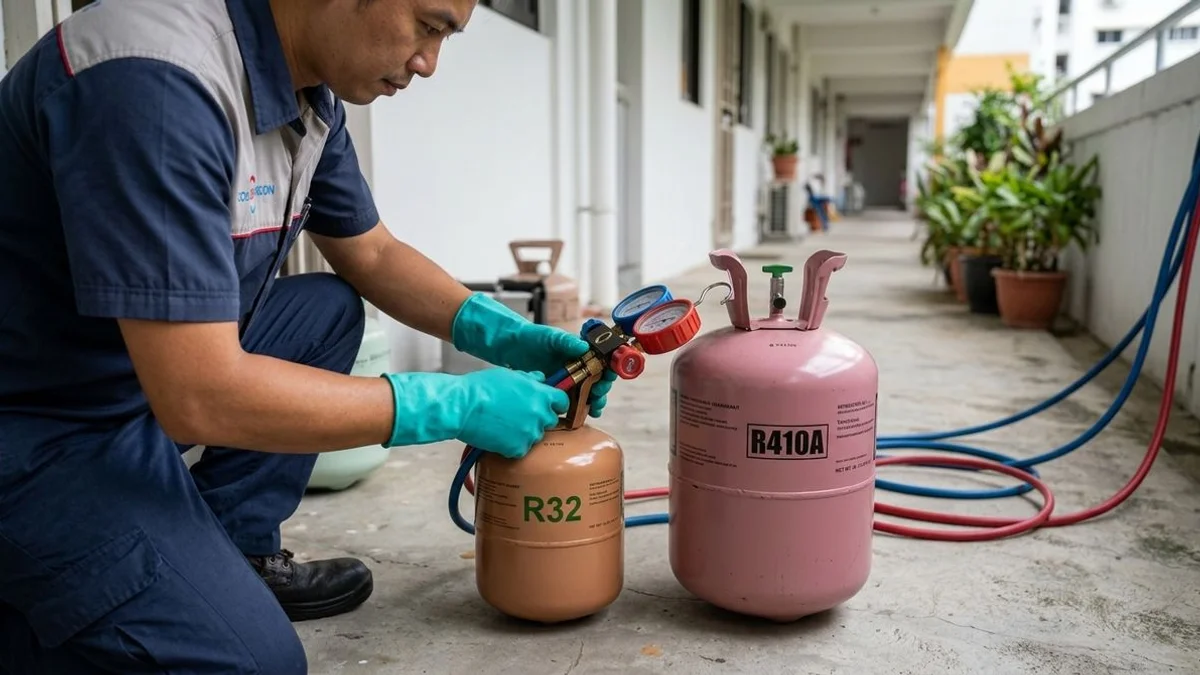
Most aircons sold in Singapore from 2020 onwards run on R32 refrigerant; older units typically run on R410A (or further back, R22). The transition isn’t just a label change — it affects aircon gas top-up cost, procedure, and what happens at end-of-life.
This guide explains the practical differences for Singapore homeowners. To work out whether your unit actually needs a top-up now, see when gas top-up is needed.
What’s the difference between R32 and R410A?
Both are HFC (hydrofluorocarbon) refrigerants used in residential aircon systems. The key differences:
| Property | R32 | R410A |
|---|---|---|
| Composition | Single component (difluoromethane) | Blend (50% R32, 50% R125) |
| GWP (Global Warming Potential) | 675 | 2,088 |
| Cooling efficiency | ~10% higher | Baseline |
| Flammability class | A2L (mildly flammable) | A1 (non-flammable) |
| Charge size for same BTU | ~30% less | Baseline |
| Cost per kg in Singapore (2026) | ~S$45 | ~S$70 |
R32 is more efficient, lower-GWP, and cheaper per kg — which is why manufacturers have moved to it. R410A isn’t being phased out yet but is gradually being replaced in new units.
Which refrigerant does my aircon use?
Two ways to check:
- Look at the indoor unit label (usually on the right side of the casing). It will say “Refrigerant: R32” or “Refrigerant: R410A”.
- Look at the outdoor condenser nameplate. The refrigerant type is printed alongside the model number and serial.
If your unit was purchased before ~2018, it’s almost certainly R410A. After ~2020, almost certainly R32. The 2018–2020 transition window has both, depending on brand.
Can I mix the two? (No.)
This is the most common misconception. You cannot mix R32 and R410A. The two operate at different pressures, react differently with the compressor oil, and have different flow characteristics through the expansion valve.
If a technician offers to “top up R410A with R32 because it’s cheaper,” refuse and find a different technician. The compressor will fail within months, turning a S$80 top-up into a S$700+ replacement.
Can my R410A unit be retrofitted to R32?
Almost never economical. A retrofit requires:
- Flushing the entire system to remove R410A residue
- Replacing the compressor oil (R32 uses different oil chemistry)
- Replacing the expansion valve
- Re-pressure testing the entire copper run
In practice, the retrofit cost (S$600+) is most of the way to a new R32 unit (S$1,100+ installed). The economic answer is to keep running the R410A unit until end-of-life and replace with R32 at that point.
Top-up cost difference
Because R32 is cheaper per kg AND systems use 30% less of it, R32 top-ups in Singapore are noticeably cheaper:
| System | R32 top-up | R410A top-up |
|---|---|---|
| 9,000 BTU (1.0 kg charge) | S$80–S$110 | S$120–S$150 |
| 12,000 BTU (1.4 kg charge) | S$100–S$140 | S$150–S$190 |
| 18,000 BTU (2.0 kg charge) | S$130–S$180 | S$200–S$260 |
R22 (the older refrigerant in pre-2010 units) is the most expensive — S$80+ per kg and supplies are limited. If your unit is on R22 and needs frequent top-ups, replacement is usually the right call.
Servicing differences
Day-to-day servicing (chemical wash, drain flush, capacitor checks) is identical for R32 and R410A. The only differences:
- R32 requires brazing-trained technicians for any pipework repair (the A2L classification means small flame-handling differences). All Coolbest technicians are R32-certified.
- R32 leak detection is slightly easier because R32 has a faint odour at significant leak concentrations. R410A is essentially odourless.
- Recovery requirements are the same (must be reclaimed, not vented to atmosphere) but R32 cylinders are a different fitting from R410A.
Environmental angle
R32 has a GWP about one-third of R410A. For a typical Singapore household aircon (1.4 kg charge), the lifetime climate impact difference is roughly equivalent to driving 5,000 km less. Not enormous in the scheme of household carbon, but a meaningful improvement.
If you’re choosing a new unit and have the option of either, R32 is the better environmental choice as well as cheaper to maintain.
What about R290 (propane) and R454B?
Some manufacturers are testing R290 (propane) and R454B as next-gen refrigerants. As of 2026, neither is in widespread Singapore residential use. R32 will remain the dominant refrigerant for the foreseeable future.
When you call us for a top-up
Tell us the refrigerant type if you know it — saves a check on arrival. We carry both R32 and R410A on every van, plus the appropriate gauges and recovery cylinders.
If you don’t know the type, just send a photo of the indoor unit label or the outdoor condenser nameplate. We’ll identify it before the visit.
Booking
WhatsApp +65 9182 5233 with the brand, model (if known), and the symptoms (warm air, ice on copper pipe, longer-than-usual cooling). We’ll come back with the likely refrigerant, the expected top-up volume, and a slot offer.