
Aircon Leaking Water Inside the Room: Why It Happens & How to Fix It
Water dripping from the front of an aircon almost always traces back to one of five causes. Here's the diagnosis flow and the typical fix cost for each.
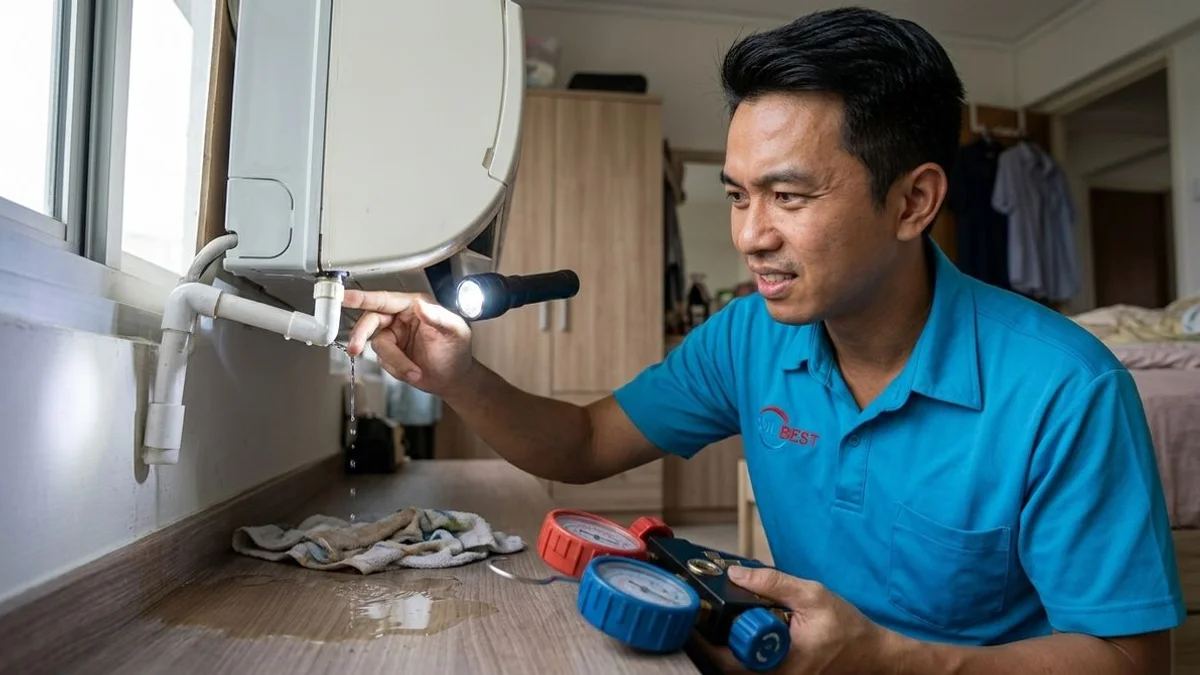
Water dripping from the front of your indoor aircon is one of the most disruptive faults — it can damage walls, ceilings, furniture, and electrical points below the unit. Fortunately it’s also one of the most diagnosable: nine times out of ten the cause is one of five things. The fix is almost always a straightforward aircon repair rather than a replacement.
This guide walks through the causes in order of likelihood and what the fix typically looks like. For a related concern, see our guide on noisy aircons.
Cause 1: Clogged drain pipe (most common — ~60% of cases)
Fix: drain pipe pressure flush, S$80. Time: 15–30 minutes.
The drain pipe carries condensate from the unit’s drain pan to an external outlet. Over months, biofilm and dust build up inside the pipe, slowing the drainage. Eventually water backs up into the drain pan faster than it can clear, overflows, and drips out the front of the unit.
This is by far the most common cause of indoor water leaks. It’s also the easiest fix — we use a pressure pump to flush the pipe end-to-end, then verify the discharge at the outlet.
Routine quarterly servicing prevents this entirely; the drain flush is part of the standard checklist.
Cause 2: Tilted or sagging fan coil (~15% of cases)
Fix: rebracket and re-level, S$120–S$180. Time: 1–2 hours.
Aircon fan coils are mounted with a slight downward tilt toward the drain side, so condensate naturally flows into the drain pan. Over years, the mounting bracket can shift slightly — wall anchors loosening, the bracket bending under weight — until the tilt is reversed.
When the unit tilts the wrong way, water collects on the wrong side of the drain pan and spills out the front.
Symptoms: water drips out one specific side of the front, not the centre. Often visible from below as a single drip path.
The fix involves removing the unit from the wall, re-checking the bracket level, re-anchoring if needed, and remounting with proper tilt.
Cause 3: Frozen evaporator coil melting (~10% of cases)
Fix: identify root cause (low gas, blocked airflow), then service or top-up, S$80–S$200. Time: 1–2 hours including defrost.
If the coil has frozen solid (typically due to low refrigerant or a severely blocked filter), the ice eventually melts when the system cycles off — and that meltwater is usually too much for the drain pan to handle, so it overflows.
You’d usually notice this alongside the cooling failing — warm air with water dripping. The root cause is what we fix; the dripping resolves automatically once the unit isn’t freezing any more.
Cause 4: Cracked drain pan (~10% of cases)
Fix: drain pan replacement, S$180–S$280. Time: 2–3 hours.
The drain pan is a U-shaped plastic or metal tray under the cooling coil. In older units (8+ years), the plastic can crack from years of thermal cycling, or the metal can corrode through.
Symptoms: water drips from a different spot than the drain outlet, and the dripping doesn’t stop after a drain flush.
The fix involves dismantling the fan coil to access the pan and replacing it. Most pan replacements are doable as a same-visit job once we confirm the part is in stock.
Cause 5: Low refrigerant causing excess condensation (~5% of cases)
Fix: leak test + refrigerant top-up, S$80–S$200. Time: 60–90 minutes.
When a system runs low on refrigerant, the coil can drop below normal operating temperature, causing more condensation than the drain pan was designed to handle. Combined with reduced airflow (often happens together), the excess condensate can overflow.
This is the rarest of the five causes for a leak (usually low refrigerant manifests as warm air rather than dripping), but it does happen.
Diagnostic shortcut you can do yourself
Before calling, do this 60-second check:
- Open the front panel and look inside.
- Is there visible ice on the cooling coil? → Cause 3 (frozen coil).
- Is the drain pan brimming with water? → Cause 1 (clogged drain).
- Is the water dripping from one specific side? → Cause 2 (tilt).
- None of the above and no obvious source? → Cause 4 (cracked pan) or Cause 5 (refrigerant).
This tells us roughly what to expect when the technician arrives, which speeds up the diagnosis.
What the visit looks like
When you book, the technician arrives with:
- Hand pump for drain flush
- Replacement drain pan (common sizes for Daikin, Mitsubishi, Panasonic)
- Spirit level for tilt check
- Pressure gauge for refrigerant test
- Multimeter for capacitor health (related-issue check)
In 80% of leak calls we identify the cause and fix it in a single visit. The remaining 20% (typically cracked drain pan in less common brands) need a return visit with the specific replacement part.
Booking and timing
Same-day slots Mon–Sun, 9am–6pm. Water leaks are treated as priority calls — we try to fit them into the next available slot rather than the standard queue.
WhatsApp +65 9182 5233 with the brand, age, and where the water is dripping from (centre of the unit, one side, or onto the wall behind).