
Noisy Aircon: What's Actually Wrong?
Aircon noise type tells you the fault type. Rattling, buzzing, whistling, clicking, gurgling — each points to a different fix. Match the sound to the cause here.
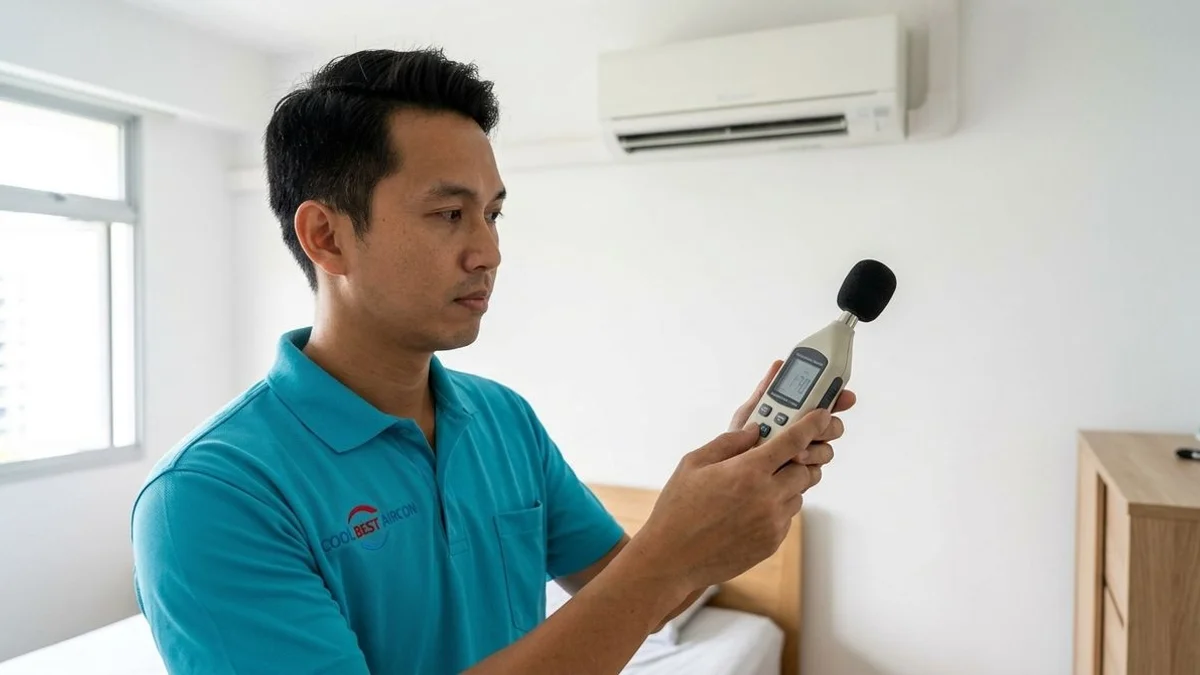
Aircon noise is annoying but informative. Each sound type points to a different fault — and almost all of them are a quick aircon repair if diagnosed early. This guide maps the five most common noise types to their typical causes and fixes, so you can make a useful WhatsApp message when you book. If the unit is also blowing warm air, cross-check with our guide on why your aircon is not cold.
Rattling: loose panel or fan wheel
Most likely cause: loose front panel or unbalanced fan wheel. Typical fix: re-clip panel (free during routine service) or fan wheel rebalance (S$80–S$120).
A rattling noise — irregular, quick, often louder at certain fan speeds — usually means something is loose. The most common culprits:
- Front panel clips that have worked loose over years
- Filter that hasn’t been seated correctly after cleaning
- Fan wheel imbalance from caked dust on certain blades
- Loose screw somewhere in the casing
The first two are usually fixable in 5 minutes during routine servicing. The fan wheel rebalance involves removing the wheel, cleaning it thoroughly, and refitting — included in chemical wash work.
If rattling appears suddenly and is loud, switch off and check — it could be a cracked fan blade, which needs immediate attention before pieces break free.
Buzzing: capacitor or contactor problem
Most likely cause: failing capacitor or contactor in the outdoor condenser. Typical fix: capacitor S$120, contactor S$100.
A buzzing noise from the outdoor unit (the box on the external wall) usually means an electrical component is struggling. The two prime suspects:
- Failing start capacitor — the compressor is trying to start but doesn’t have enough surge capacity. You may also notice the compressor humming without actually starting.
- Failing contactor — the relay that switches power to the compressor is sticking or buzzing under load.
Both are common 6–10 year wear items. Both are S$80 diagnosis + the part. Both should be fixed within 24 hours of noticing — running the system with a failing capacitor will eventually burn out the compressor, which is a much more expensive failure.
Whistling: refrigerant leak or duct gap
Most likely cause: refrigerant leak at a copper joint, or air leak around the wall conduit. Typical fix: leak repair S$200+, conduit reseal S$80.
A continuous high-pitched whistle, especially audible at night when the room is quiet, usually points to a small refrigerant leak at a brazed copper joint. The high-pressure refrigerant escapes through the pinhole, producing the whistling sound.
Less commonly, a similar whistling can come from an air leak around where the copper pipe enters the wall — the conduit foam or putty seal has cracked.
A leak repair on a copper joint is more expensive than a top-up, but it’s the right fix — topping up a leaking system buys weeks at most.
Clicking: thermostat relay or expansion valve
Most likely cause: thermostat relay clicking on/off, or expansion valve operating normally. Typical fix: usually no fix needed (normal operation), or thermostat sensor S$80.
A regular click — once every 30 seconds, or once every few minutes — is usually normal operation. The thermostat relay clicks when the unit cycles, and the electronic expansion valve clicks when it adjusts refrigerant flow.
A click that keeps repeating rapidly (every 1–2 seconds) is not normal and indicates the relay is faulty. Switch off and book a diagnosis.
Gurgling: refrigerant flow or drain issue
Most likely cause: low refrigerant or air in the drain pipe. Typical fix: refrigerant top-up S$80+ or drain flush S$80.
A gurgling sound — like water moving through a partly filled pipe — can come from two places:
- The refrigerant lines if the system is low on gas, allowing pockets to form
- The drain pipe if condensate isn’t flowing freely
The two are easy to tell apart: refrigerant gurgle is heard near the indoor unit during cooling; drain gurgle is heard near the drain outlet (usually at the wall conduit).
For refrigerant gurgle: pressure test, leak find, top-up. For drain gurgle: pressure flush of the pipe.
Quick noise-to-fix matrix
| Noise | Likely cause | Cost |
|---|---|---|
| Rattling | Loose panel or fan wheel | S$0–S$120 |
| Buzzing (outdoor) | Capacitor or contactor | S$100–S$120 |
| Whistling | Refrigerant leak | S$200+ |
| Clicking (rapid) | Thermostat relay | S$80 |
| Clicking (slow) | Normal operation | None |
| Gurgling (indoor) | Low refrigerant | S$80+ |
| Gurgling (outdoor) | Drain pipe blockage | S$80 |
What to send when you book
A 5-second voice memo of the noise from your phone is often all we need to narrow it down before the technician arrives. WhatsApp +65 9182 5233 with:
- The audio clip
- Whether the noise is from the indoor or outdoor unit
- When it started (suddenly, gradually)
- What fan setting it’s loudest at
We’ll come back with a likely diagnosis and a slot offer.