
Daikin vs Mitsubishi Starmex: Which Aircon Suits Your Singapore Home?
Two of the most popular aircon brands in Singapore — but which one suits your room, budget, and usage pattern? Here's the field-tested comparison from 18 years of installs.
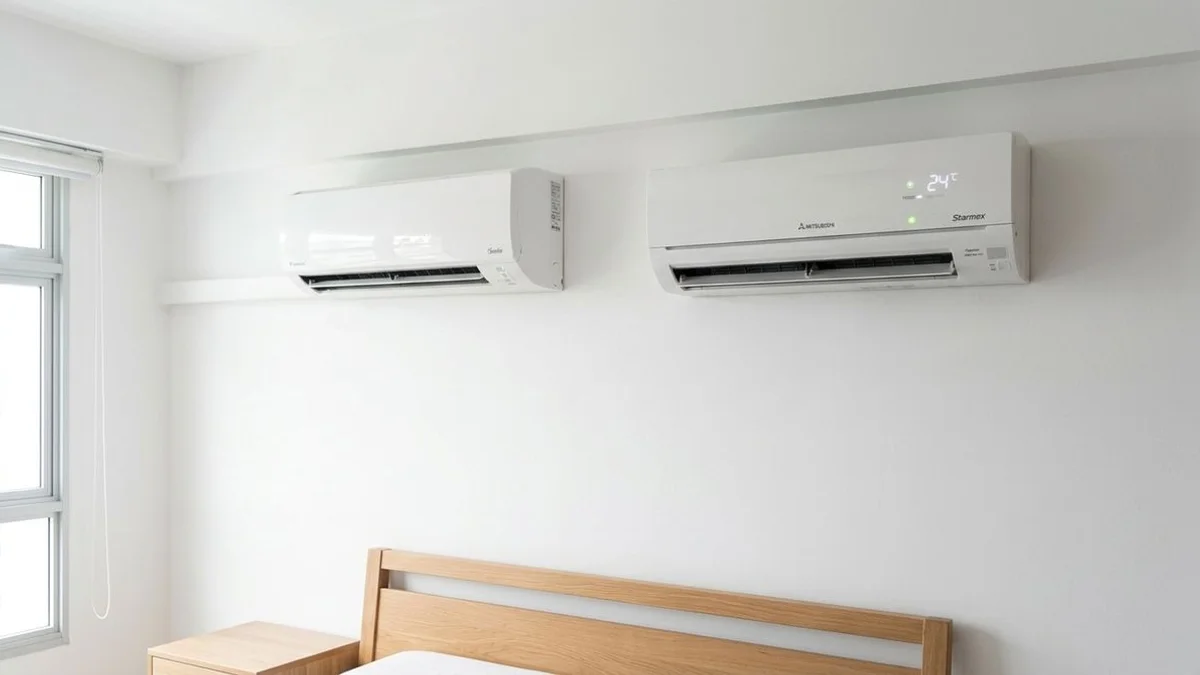
Daikin and Mitsubishi are the two most popular aircon brands in Singapore HDB and condo bedrooms. The question we get most often when quoting aircon installation is: “which one should I pick?”
The honest answer depends on the room, the usage, and your priorities. Here’s a head-to-head comparison from 18 years of installs and repair calls. If you’re also weighing refrigerant choice, see our R32 vs R410A breakdown.
Energy efficiency (NEA tick rating)
| Model | NEA Tick Rating | Indicative annual kWh (9000 BTU, 8h/day) |
|---|---|---|
| Daikin iSmile (FTKF) | 5 ticks | ~480 kWh |
| Mitsubishi Starmex (MSXY) | 5 ticks | ~470 kWh |
Both top out at 5 NEA ticks for the recent inverter models. Mitsubishi Starmex has a marginal kWh edge in lab conditions; in real Singapore homes the difference is within noise and not worth choosing the brand for.
Cooling comfort
Small rooms (HDB bedroom, 2.7m × 3.0m)
For typical HDB bedrooms, both 9,000 BTU models cool effectively. The cooling approach differs slightly:
- Daikin iSmile — uses Smart Eye motion detection to lower output when the room is empty, conserving energy
- Mitsubishi Starmex — uses 3D i-See sensor to detect occupant location and direct airflow
For solo sleepers in a closed bedroom, Daikin’s quieter low-speed mode wins for comfort. For bedrooms with kids who move around, Mitsubishi’s directional airflow is slightly better.
Larger rooms (HDB living room, 4.5m × 5.0m)
For 12,000 BTU and 18,000 BTU units in larger spaces, Mitsubishi has the slight edge. The Starmex Hyper Heating range maintains output more consistently at the room edges, which matters in larger living rooms with 1+ external walls.
Noise level
Bedroom noise is a frequent complaint. Both brands are quiet, but Daikin iSmile is the quietest at minimum fan speed.
| Mode | Daikin iSmile | Mitsubishi Starmex |
|---|---|---|
| Quiet (low fan) | 19 dB | 21 dB |
| Medium fan | 33 dB | 32 dB |
| High fan | 44 dB | 42 dB |
Daikin wins at the low end (bedroom comfort). Mitsubishi wins slightly at higher fan speeds (less perceived loudness when cooling fast).
Reliability and parts availability
Both brands have authorised distributors in Singapore with strong parts availability. From our repair-call experience:
Daikin
- Strong compressor durability (rare to see compressor failures before year 10)
- Slightly more PCB (control board) issues, especially on units installed 2018–2020
- Capacitor and contactor failures in line with industry average
- Indoor unit casings hold up well
Mitsubishi Starmex
- Strong overall reliability — fewest “system-down” calls in our history
- Compressor durability slightly better than Daikin (fewer pre-year-10 failures)
- Drain pan plastics slightly more brittle on older models (rare but possible)
- Outdoor casings excellent in Singapore’s coastal humidity
Typical installed cost in HDB and condos
| Model size | Daikin iSmile (installed) | Mitsubishi Starmex (installed) |
|---|---|---|
| 9,000 BTU single split | S$1,100–S$1,300 | S$1,150–S$1,350 |
| 12,000 BTU single split | S$1,250–S$1,450 | S$1,300–S$1,500 |
| Multi-split 4 fan coils (mixed BTU) | S$4,400–S$4,900 | S$4,600–S$5,100 |
Daikin is typically S$50–S$150 cheaper at install. The price difference is marginal and shouldn’t drive the decision.
Our honest recommendation by room count
1–2 unit HDB bedrooms only
Pick Daikin iSmile. The lower noise floor and the slightly lower install cost make it the practical winner for bedrooms-only setups.
3–4 unit HDB whole-home
Pick either, lean Mitsubishi Starmex if you have larger living spaces or a west-facing aspect (afternoon sun). The slightly stronger cooling at the room edges matters for 18,000 BTU living-room units.
5+ unit large condo or landed
Pick Mitsubishi Starmex. The marginal edge in long-term reliability matters more when you’re managing more units. Same brand throughout also simplifies remote control and parts inventory.
Budget-constrained
Pick Daikin Smile (entry-level) rather than the premium iSmile or Starmex. The Smile range is roughly S$200–S$300 cheaper per fan coil installed and still 4-tick rated. Reliability is slightly behind the premium tiers but still solid.
What about Panasonic, Toshiba, LG?
We install all three regularly:
- Panasonic X-Deluxe — best dehumidification (excellent for west-facing rooms in Singapore)
- Toshiba Hi-Wall — best value entry point for budget-conscious HDB installs
- LG DualCool — newest inverter tech, fast cooling
If you’ve narrowed to Daikin vs Mitsubishi, the comparison above applies. If you’re still open, ask us about Panasonic for high-humidity rooms.
Get a brand-neutral install quote
Coolbest carries no brand quotas. The recommendation we give depends on your room, usage, and warranty preference — not on which brand pays us best.
WhatsApp +65 9182 5233 with the room dimensions and approximate usage hours, and we’ll come back with a brand recommendation and a written quote.