
HDB Aircon Installation Rules in Singapore: BCA Brackets, Conduit & Compliance
HDB and BCA have specific rules for aircon brackets, conduits, and drainage. Skip them and you risk fines, reinstall costs, or being denied resale clearance. Here's what compliant installation looks like.
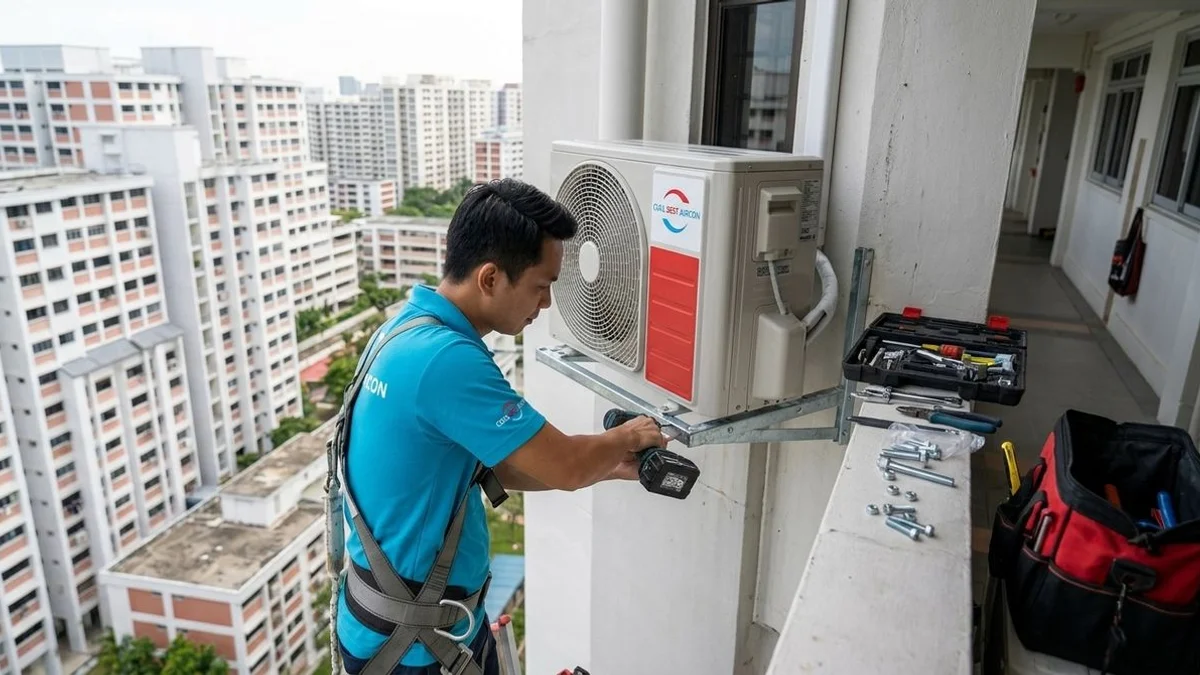
HDB and BCA have specific rules for aircon installation in Singapore — most homeowners don’t realise this until something goes wrong. A failed resale inspection, a fine for an unapproved bracket, or worse, a falling condenser, all trace back to the same root cause: cutting corners on installation compliance.
This guide walks through what HDB and BCA require, what compliant installation actually looks like, and what to ask your installer before you commit. If you’re still shortlisting models, see Daikin vs Mitsubishi Starmex for the brand comparison most relevant to HDB homes.
Why HDB and BCA care about aircon installation
Aircon condenser units are heavy (40–80 kg for residential) and mounted on external walls — often above public walkways. A falling unit is a serious public safety risk. HDB and BCA’s rules exist to:
- Prevent falling condensers (bracket strength and corrosion resistance)
- Prevent water damage to neighbours’ property (drainage routing)
- Prevent electrical fires (conduit standards)
- Maintain the building façade (visual standards on common corridors)
These rules apply to every HDB flat, regardless of age or estate. Some condo MCSTs add additional rules on top.
Approved brackets only
HDB requires aircon condenser brackets to meet BCA load and corrosion standards. Approved bracket characteristics:
- Material: Hot-dip galvanised steel or marine-grade stainless steel (SS304 minimum)
- Load rating: Minimum 4× the unit weight (so a 60 kg condenser needs a 240 kg+ rated bracket)
- Anchoring: Through-bolt or chemical anchor into the structural concrete (not into brick or render)
- Corrosion test: Salt-spray tested to ISO 9227 minimum
The cheapest “generic” brackets sold online don’t meet these standards. They look similar but use thinner steel, lower-grade welds, and weaker anchors. They’ll pass the day-one install — but fail at year 5–8, often during the monsoon when the condenser experiences peak vibration.
Conduit and pipe routing rules
The copper refrigerant pipes and electrical conduit between the indoor and outdoor units must be routed through approved channels:
- External conduit must be UV-stable PVC (not standard plumbing PVC)
- Pipe insulation must be closed-cell foam, minimum 9 mm thickness
- Wall penetrations must be sealed with fire-rated mastic on both sides
- Drainage pipes must discharge to an approved point (not over a walkway, not onto a neighbour’s window)
The most common HDB flag at resale inspection is improperly sealed wall penetrations — a 10-second mastic application that the installer skipped.
Drainage rules
Aircon condensate (the water that drips from the indoor unit) is treated as wastewater under HDB rules. It must:
- Drain to an approved discharge point (kitchen yard floor trap, balcony floor trap, or dedicated condensate drain)
- Not discharge over the external wall (drips onto people below)
- Not discharge into the rainwater drain (capacity issues during monsoon)
- Be routed in PVC, not flexible hose, in any visible section
Older flats with no nearby floor trap may need a small condensate pump installed. We carry these as standard for HDB jobs.
Common corridor (corridor-facing) installations
If your aircon condenser sits on a common corridor wall (some HDB layouts), additional rules apply:
- The condenser must not project more than 600 mm from the wall
- The bottom of the condenser must be at least 2.1 m above the corridor floor
- A drip tray is mandatory (catches condensate before it reaches corridor floor)
- Cosmetic standards apply (no exposed insulated copper)
These rules are about pedestrian safety and visual standards. Failure to comply is the most common HDB enforcement issue.
What happens if you skip the rules
Three real-world consequences we see regularly:
1. Resale inspection failure
When you sell the flat, HDB inspects fixtures including aircon installations. Non-compliant brackets or pipework gets flagged, and you must remediate before completion can proceed. Typical remediation cost: S$200–S$600 to redo brackets, conduit, and sealing.
2. HDB enforcement letter
Neighbours can complain about water dripping, exposed wires, or visible non-compliance. HDB then issues a formal letter requiring rectification within 14–30 days. Ignore it and there’s a fine.
3. Insurance disputes
If a non-compliant install causes damage (water leak into a neighbour’s flat, corroded bracket failing), your home insurance may decline the claim because the work wasn’t done by a qualified installer to BCA standards.
What to ask your installer before booking
Five questions that filter out bad installers:
- “What bracket model and grade do you use?” — Should answer with a specific HDB-approved model name (e.g., “We use Sumo SB-50 SS304” or similar). A vague “standard bracket” answer is a red flag.
- “What conduit and insulation thickness?” — Should answer 9 mm or 13 mm closed-cell foam, in UV-stable PVC conduit.
- “Where will you discharge the condensate?” — Should identify the floor trap or dedicated drain on your specific layout, not “out the wall.”
- “Are you a BCA-registered installer?” — All Coolbest technicians work under our BCA-registered tradesperson licence. Generic handymen often aren’t.
- “Can you provide a written compliance certificate?” — A short signed document confirming the install meets HDB/BCA standards. Useful for resale and insurance.
What Coolbest provides as standard
Every HDB installation we do includes:
- HDB-approved hot-dip galvanised bracket (minimum), SS304 on coastal blocks
- 9 mm closed-cell foam pipe insulation, full-length
- UV-stable PVC external conduit
- Mastic-sealed wall penetrations both sides
- Approved-discharge condensate routing (or pump if needed)
- Written compliance certificate at handover
- 1-year installation workmanship warranty
Pricing and timing
Standard HDB single-split installation: S$1,100–S$1,300 depending on brand and BTU. Multi-split (4 fan coils): S$4,400–S$4,900.
Most installations are completed in 4–6 hours per system. Multi-splits typically take a full day.
WhatsApp +65 9182 5233 with your block number, the model you’re considering, and where you want the condenser placed. We’ll come back with a written quote and a compliance checklist within the hour during business hours.